Member's Portal

Stories & Articles
Getting into the Groove - Part 1
Returning to study can feel like both a fresh start and a daunting step. For many learners—particularly those balancing work, family, and other commitments—the beginning of the academic year brings excitement alongside uncertainty. Whether you are returning after a break or stepping into formal study for the first time, this transition marks an important moment of change and possibility. The good news is that this adjustment is a process—and one you don’t have to navigate alone.
In this series of posts, I’ll be sharing practical tips, strategies, and insights to help you navigate the transition back into study. From managing your time effectively to building confidence in your learning, the goal is to provide guidance that is both realistic and actionable. Whether you’re a returning student, exploring postgraduate study, or simply looking to make the most of your learning journey, these posts are designed to support you as you settle back into the rhythm of being a student.

Julie Edwards
Julie Edwards (PhD) is an experienced educator and founder of MBS Global PD, specialising in practical, skills-focused professional development.
Welcome to the first in the "Getting into the Groove" Series
Studying can be a challenging endeavour, especially for adult students balancing a full-time job, a business, and family responsibilities. My own educational journey began after watching Educating Rita (Gilbert, 1983), a movie based on Willy Russell’s play. The story follows a working-class woman in Liverpool who decides to study literature at The Open University and faces a range of obstacles along the way. (The movie is now available on YouTube.)
Like Rita, I also studied literature, and I often joke that I transformed from a student like her into a lecturer—though I’m not the alcoholic professor portrayed by Michael Caine! Over the years, as an adult educator, I’ve witnessed the transformative experiences of many students, the challenges they faced, and the strategies they used to succeed. These insights have inspired me to create content that addresses the real struggles of mature students.
I’m excited to announce the launch of a YouTube channel, blog series, and workshops designed to support your educational journey. I encourage you to follow and engage with my content, where I’ll share ideas and practical tips to help reduce stress, build confidence, and make the return to study more manageable and rewarding.
Read the subject outline - check the assessment due dates
Assessment Overview
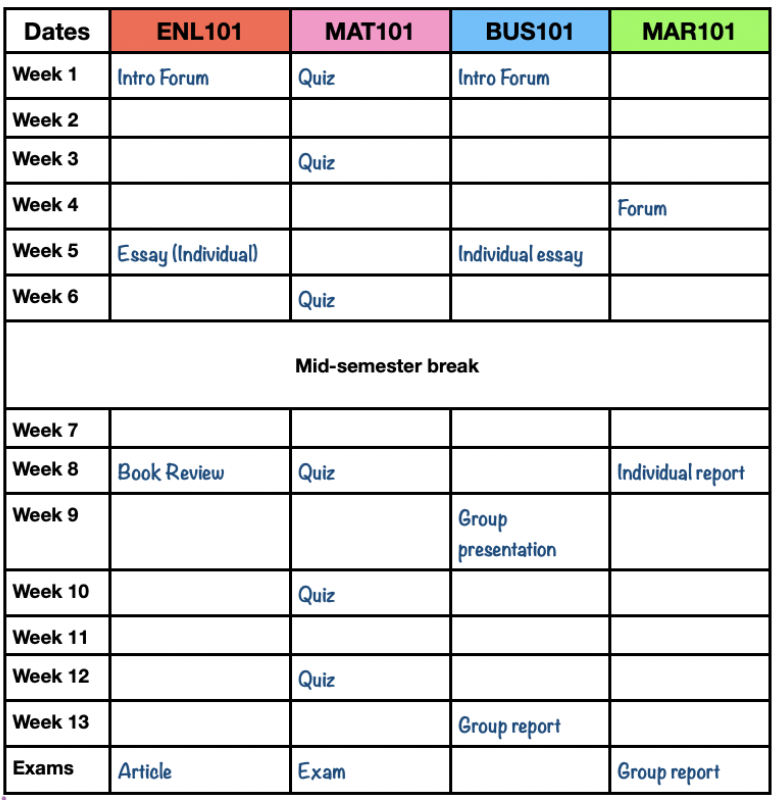
While it may seem straightforward, gaining access to your subject outline is a critical first step. Be sure to download it and take the time to familiarize yourself with the due dates and identify whether each assessment is individual or group-based. Creating an Assessment Overview, like the one shown in the image is an effective way to stay organized.
Start with Your Subject Outline
Accessing your subject outline is a critical first step. Download it early and take time to:
Note key due dates
Identify which assessments are individual vs. group-based
Create an Assessment Overview to visualize your semester (like the example shown in the image)
Organize with Color Coding
Assign a distinct color to each subject and use the same color in your diary to mark lesson times. This strategy helps:
Keep your schedule clear and consistent
Make it easy to spot overlaps or busy periods
Plan Around Your Semester Length
For 10-week trimesters, adjust your Assessment Overview to suit the condensed schedule
Visualizing assessment dates early helps prevent last-minute surprises
Check Your Commitments
Review personal, family, and work commitments for potential conflicts
Plan ahead to avoid clashes with deadlines or group meetings
Be Proactive with Group Work
Schedule time with group members as soon as teams are announced
Early collaboration reduces stress and sets you up for success
Colour-Code Your Diary
Whether you use an electronic or paper diary, colour coordination helps you stay organized.
Block out all class times, including face-to-face and online sessions.
For Zoom classes, add the meeting link directly to the diary entry for easy access.
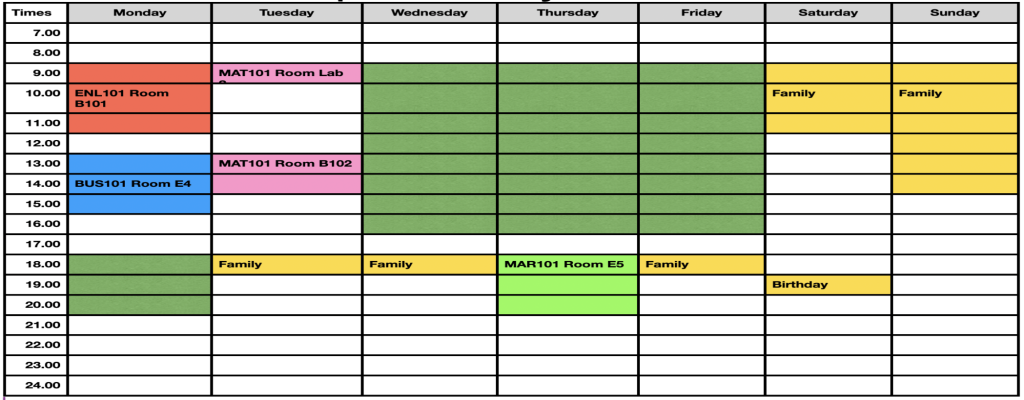
Assign colours to different categories: subjects, work, and family events.
Keep Everything in One Diary
Many students use multiple diaries, but one diary is simpler and more effective.
Track all due dates, classes, work meetings, team meetings, and family commitments in one place.
Using colours consistently helps you quickly identify priorities and avoid scheduling conflicts.
Example Layout
Family events: yellow
Work events: green
Subjects: labelled as per your visual overview
This example shows a student returning to full-time study with a part-time job, though many mature students manage full-time work with part-time study. Adjust the layout to suit your personal situation.
Summary
A colour-coded, single diary is your secret weapon for managing study, work, and life. Block out classes, work, and family events, review regularly, and stay on top of deadlines. Start small, find what works, and watch your diary become a roadmap to focus, balance, and success.
📌 Learn More
I’ll soon be adding a YouTube video demonstrating both paper and electronic diary planning, giving you practical tips to set up your schedule efficiently.
References
Gilbert, L. (1983). Educating Rita [Film]. YouTube. https://www.youtube.com/watch?v=v6aKJzmas70
YouTube Channel Tutorials
If you need to learn how to use your computer to produce assessments, subscribe to my YouTube channel, where I regularly add new, easy-to-follow tutorials.
The first five videos guide you step by step through creating a Microsoft Word document for assessments, including how to:
Set up a professional front cover
Insert an automatic table of contents
Add images and create an automatic list of images
Insert tables and create an automatic list of tables
Use SmartArt to create charts
These tutorials will help you quickly create a reusable assessment template, saving time and reducing stress. Remember to always check your college or institution’s instructions for final formatting and adapt your document accordingly. For example, when using APA referencing, titles are placed above images and tables.
quick links
join our Newsletter
Sign up for our newsletter to enjoy free tips, inspirations, and more.